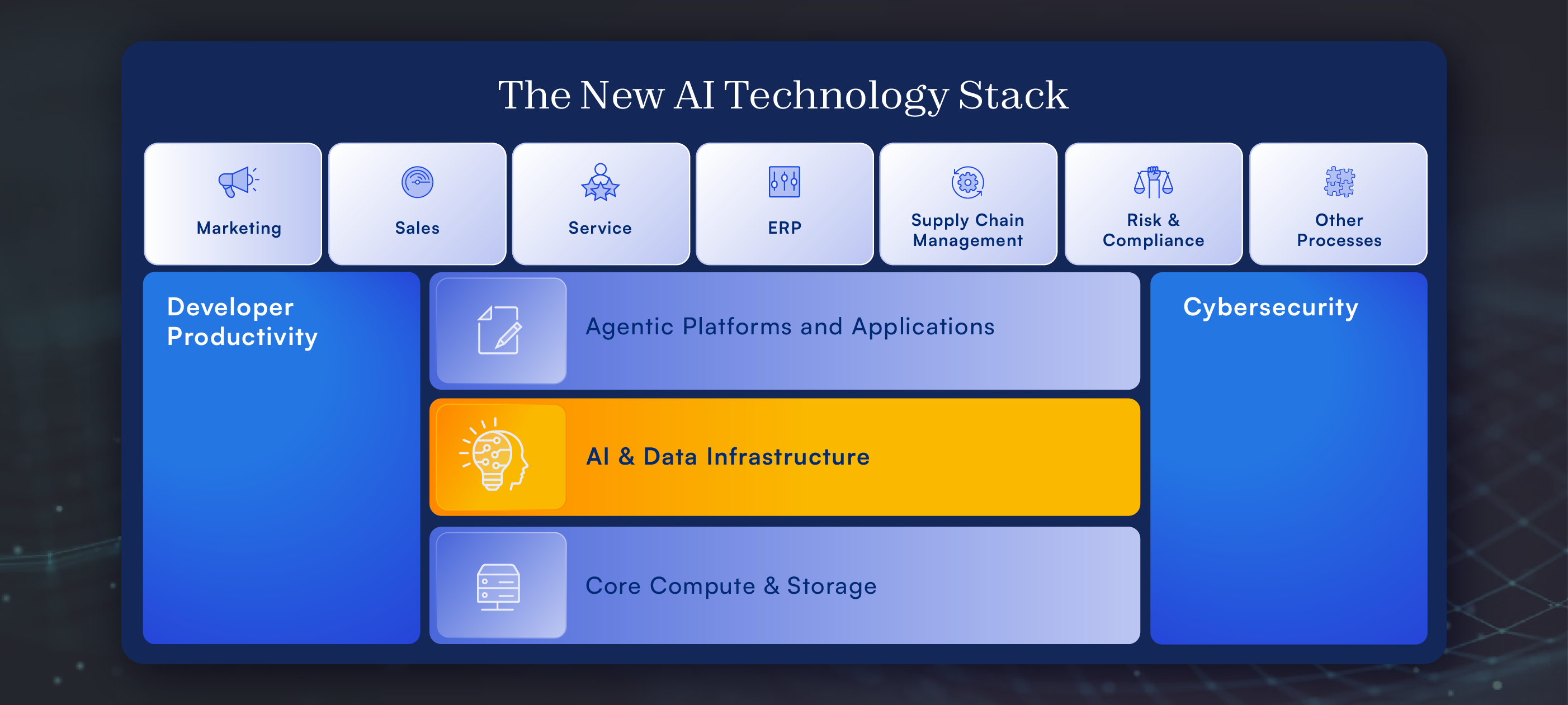
This report examines the data infrastructure layer of the new AI technology stack—the systems that store, move, transform and retrieve the information that AI agents depend on to act reliably in the real world. We explore how the shift to agentic AI is forcing a rethink of enterprise data architecture, and where we believe significant disruption and value creation are likely to occur.
In the report, we analyze why traditional data infrastructure, designed for batch processing and human-readable reports, struggles to meet the demands of agentic workloads, and how a new generation of databases, data operations tools and intelligent retrieval systems is emerging to fill the gap.
AI Landscape Series: Data Infrastructure
Access the Report
Report Highlights
1. The Data Challenge AI Amplifies
Existing enterprise data infrastructure was built for a different era—batch processing, scheduled pipelines and reports designed for human review. Agentic applications break those assumptions, requiring dynamic access to accurate, contextual information at runtime. When the underlying data is fragmented or stale, even capable models may hallucinate or miss context. We examine how the shift to agentic workloads is forcing a re-evaluation of enterprise data architecture.
2. Databases: A Market in Transition
From the enduring dominance of relational databases like PostgreSQL to the rise of multi-model, vector and hybrid transactional-analytical systems, we map how the database market is evolving to support AI workloads and where new entrants are finding room to compete against established incumbents.
3. Data Security
As enterprises open their data to AI agents, the attack surface expands. We examine the data security landscape, including how governance and access control requirements are intensifying as AI systems gain the ability to read, write and act on enterprise data at scale.
4. DataOps: Moving and Transforming Data for AI
Agentic applications don't just consume data, they depend on it being current, well-formed and continuously validated. We examine how the DataOps landscape is evolving to meet that requirement, covering data ingestion and transformation, orchestration, quality and observability. We also explore why the rise of LLMs has extended DataOps scope beyond structured pipelines to include the unstructured text, documents and logs that AI systems increasingly need to function reliably.
5. Intelligent Information Retrieval
We believe that models are only as accurate as the context they can retrieve. We examine how retrieval-augmented generation (RAG), vector search, knowledge graphs and AI-optimized search infrastructure give agents access to current, relevant information at runtime.
6. Data Infrastructure Market Map
Our market map charts the emerging landscape across enterprise data, databases, data security, DataOps and intelligent information retrieval, highlighting both established platforms and the emerging vendors we believe are positioned to support the next generation of AI applications.

Terms and Conditions
We're committed to your privacy. Georgian uses the information provided to us to contact you with relevant information about our product, services, and content. By submitting this form, you consent to receive such communications from us. For more information about how we handle and protect your data, please review our Privacy Policy. You can opt out from these communications at any time. For more information please see our Terms and Conditions and Additional Disclaimer.