Jevons paradox is a commonly cited, potentially overused, analogy in the world of AI. The original idea is the counterintuitive premise that as steam engines became more efficient, the total coal consumption went up, not down. More efficiency made steam power affordable for more industries, which in turn drove demand for the very resource that had just gotten cheaper to use.
Stated more simply: efficiency doesn’t necessarily shrink demand for a resource. It expands it as more situations can achieve a positive ROI given the newfound efficiency.
The same principle can also be applied to software development and developer productivity: As the cost of code generation drops, the appetite for software may expand into use cases previously considered too niche, too expensive, or too ephemeral to justify engineering resources. The user base for coding tools now extends beyond the estimated global population of 40M+ professional developers. Today, citizen developers and vibe coders (knowledge workers and hobbyists with no formal programming training) can use AI-assisted tools to create internal applications that automate workflows and improve efficiency.
Tools like Cursor, Replit*, Expo*, Lovable, and Claude Code can enable creators to ship in an hour what used to take a day. Product managers who couldn't open a codebase six months ago are deploying internal tools today. Vibe coders and citizen developers are building things that previously required a full engineering team.
It would seem that the obvious beneficiaries are the coding tools themselves, the ones that monetize the generation of code. But with all this new code generation and software abundance, I think the more interesting opportunity is one layer down: the infrastructure that ensures software reliability.
The cost of generating code is approaching zero, and developer demand is rising
For most of the industry's history, the constraint in software was developer time. Skilled engineers could translate business logic into working code, and everything else was built around that scarcity. In theory, you bought SaaS because building was too expensive. You outsourced whatever wasn't your core differentiator.
AI appears to be dismantling the developer time constraint. Cursor hit over $2B in annualized revenue and was recently acquired by SpaceX for $60B. Replit* reported a run rate heading toward $1B by the end of the year. In my opinion, these aren't edge cases, but signals that a fundamental shift in how software gets created is underway.
Every line of code that gets generated still needs to run somewhere. Every app a vibe coder ships still needs hosting, a database, authentication, and something to catch errors in production. If the volume of software is going up, then the infrastructure requirement per application will rise with it.
The Inner Loop got faster. The Outer Loop has yet to catch up
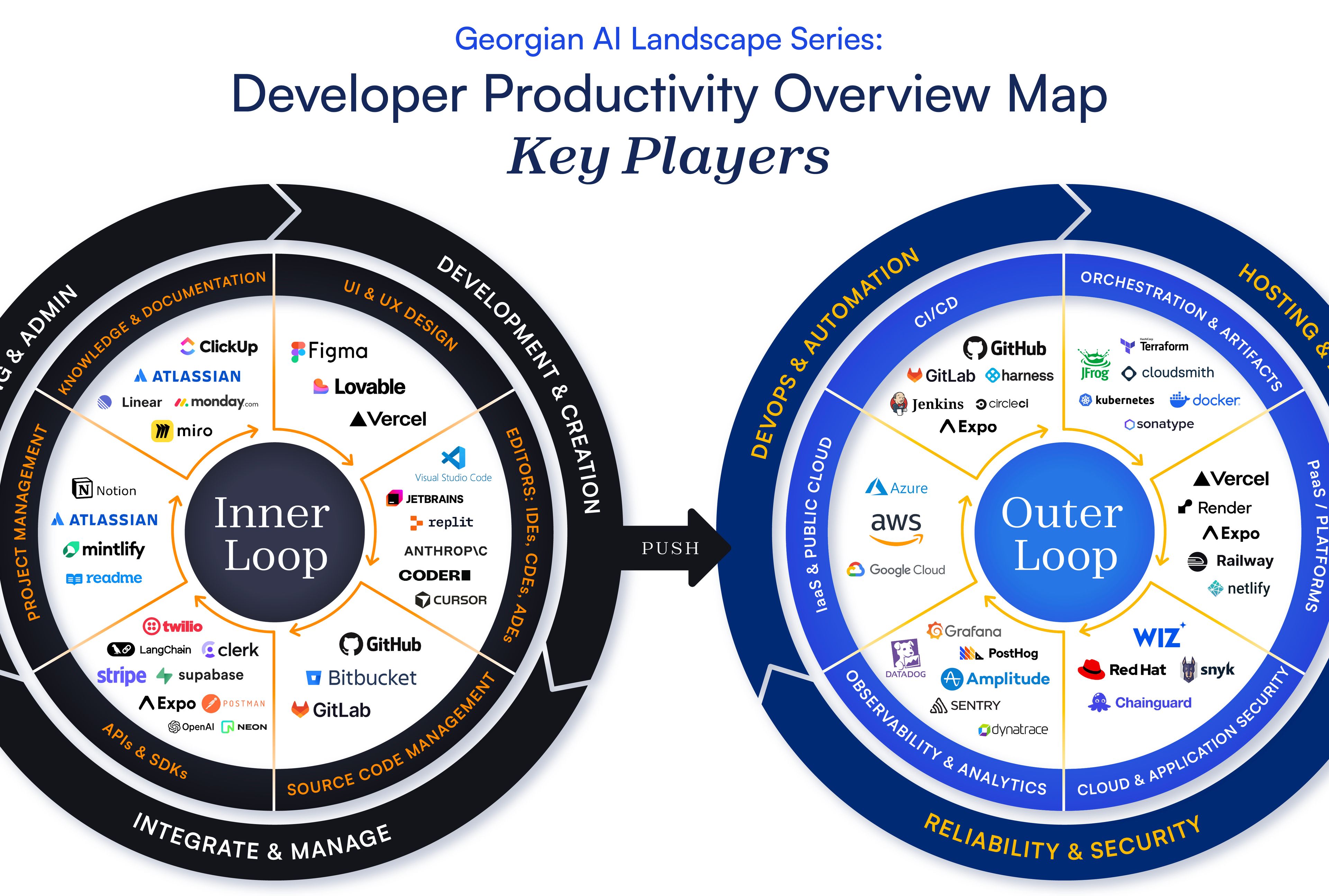
To understand why infrastructure may be the real bottleneck, you have to look at how software moves from an idea to a live product. The developer workflow can be generalized to two phases. The Inner Loop is where individual engineers write and test code: fast, iterative, individual. The Outer Loop is where organizations enforce quality, security, and compliance before code hits production: slower, more rigorous, necessarily heavier.
AI has compressed the Inner Loop. AI hasn't made the Outer Loop optional. If anything, one can argue it's made the Outer Loop more important: as AI-generated code enters production faster, at higher volumes, built by more people (including non-engineers), the need for solid deployment infrastructure, observability, and security tooling could grow.
This is where I think the most durable value is being created, not necessarily in the code generation tools themselves, but in the platforms that run and govern the output. Vercel reached a $9.3B valuation in September 2025 and recently hit $340M in ARR in February, up from $100M in 2024. Supabase hit a $5B valuation in October 2025, growing from ~$30M to $70M ARR in about eight months. These are infrastructure companies that appear to be absorbing the demand wave that AI code generation is creating.
That thesis is reflected in Georgian’s investments in the developer tool layer Expo, Render, Replit, Clerk, and Coder*, which represent our complete portfolio in this category since 2023. These investments illustrate potential paths from code generation to production that bridge between the Inner and Outer Loop.
The boring infrastructure argument
I'll admit "infrastructure is getting more valuable" isn't the most exciting headline. It potentially doesn't have the same pull as "AI will replace developers" or "anyone can build software now." Infrastructure may be less glamorous than the things that run on top of it, but if you previously weren’t technical enough to open up VS code and write some front-end logic in JavaScript and back-end logic in Python for a simple web app, you probably aren’t technical enough to secure, deploy, and manage a production-grade application… I’ll say that with some self-awareness, I'm in that camp lacking the technical skills for either :).
The Jevons Paradox logic runs straight to the following conclusion, in my opinion: If more code gets written and more apps get deployed, more things need to run reliably in production. The constraint would shift from generating code to running it at scale, keeping it secure, deploying it, and maintaining it. which appears to be a much harder problem than generating code. Software creation is becoming more accessible. I would argue that software operations are not.
I recently wrote a more detailed view of my logic and reasoning in the Developer Productivity Landscape Whitepaper published at: https://georgian.io/posts/ai-landscape-series-developer-productivity
* Replit, Coder, Clerk, Expo, Render and Chainguard are Georgian portfolio companies and represent a subset of the firm’s prior investments. The portfolio companies discussed herein may not be representative of the firm’s investment experience or performance as whole. Please contact Georgian for more information.